Key Takeaways
- Digital sovereignty: Refers to a nation’s capacity for technological autonomy across its entire digital value chain, so as to avoid foreign dependency and operational vulnerability.
- Role of open source software: A foundational basis of effective data sovereignty.
- EU Sovereignty Package: A mid-2026 initiative by the European Union to build independent technological capacity, including an Open Source Strategy.
- Democratic Agency: The argument that true digital sovereignty requires more than local infrastructure; it demands digital self-determination so that technology is democratically governed and accountable.
The term digital sovereignty is everywhere right now in relation to discussions about technology policy and digital infrastructure.
It is a subject that Link Digital, which is currently celebrating twenty-five years of using open source software to build digital infrastructure for governments and global institutions, has a direct interest in.
But what exactly does digital sovereignty mean, and why are many governments adopting it? The following article will define digital sovereignty, and the key role that open source software (OSS) play in achieving it.
Why is the digital sovereignty discussion happening now?
Why has digital sovereignty become such a major topic?
The way we think about the Internet is changing; away from the assumption that it could deliver a borderless, universally beneficial experience, to something much far different. Over the last few years, in particular, the narrative around the Internet is now characterised by regulatory enforcement, geopolitical rivalry, and the data hungry nature of the generative AI boom.
Coinciding with this, is the increasing importance of data to the operations of government, large organisations and business entities, and the advances in digital technology necessary to securely store and use it, whether publicly or privately. Computing has evolved from something to assist with back-office record keeping into the foundation of economic activity, critical national infrastructure, and political discourse.
Alongside this transition, ownership of critical digital tech stacks, everything from cloud facilities to foundational machine learning models, have become concentrated within a handful of multinational corporations operating predominantly in American and Chinese jurisdictions.
It is in this context that the capacity of governments, in particular, to retain a substantial degree of self-determination and oversight over their digital assets, infrastructure, and workflows – in other words, a degree of digital sovereignty – has become a significant issue.
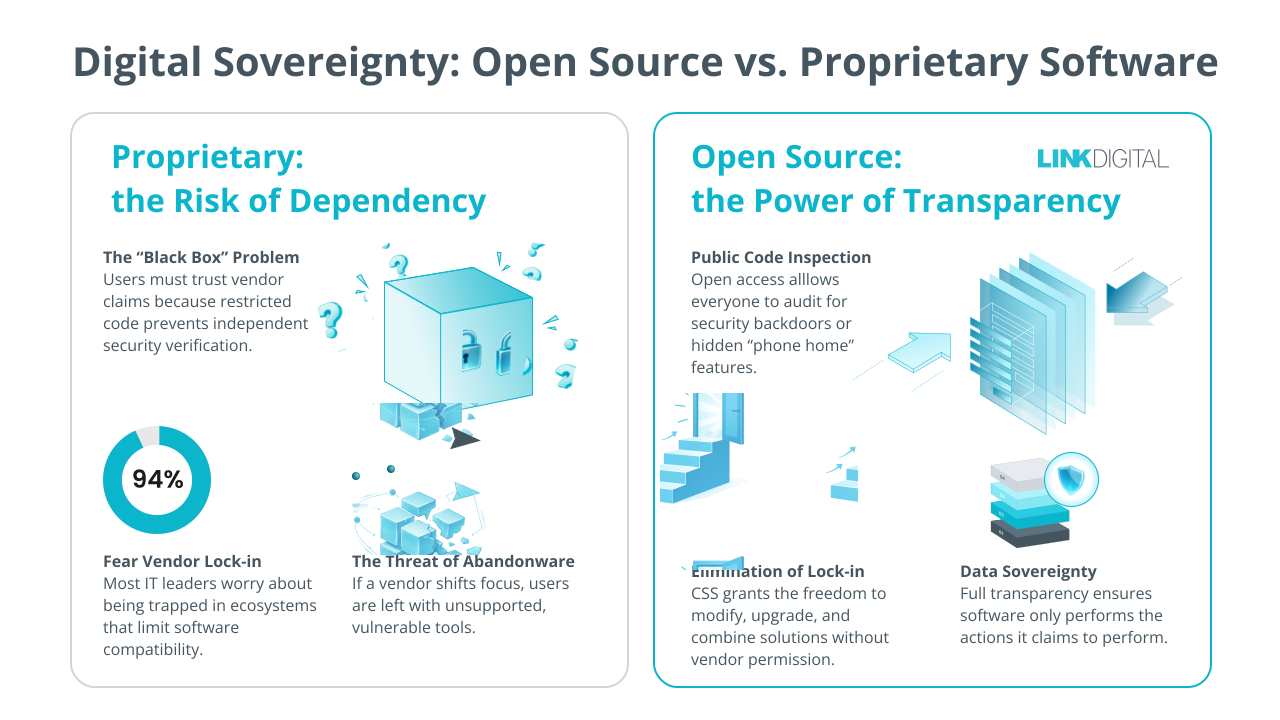
Also read: The benefits of open source compared to proprietary software
Defining digital sovereignty
It is important to clearly define digital sovereignty, as it often gets confused with another related but different term – data sovereignty.
Data sovereignty is the principle that digital information is subject to the legal structures, privacy regulations, and governance authority of the physical country or territory in which it is collected, stored, and processed. Questions like ‘what nation’s laws does a dataset fall under?’, ‘can a foreign government compel access to digital records via extraterritorial legislation’, and ‘can public and private institutions prevent the sensitive data of their citizens from being scraped by foreign commercial entities to train AI models?’, are all questions related to data sovereignty.
Digital sovereignty, on the other hand, is the overall capacity of a nation to exercise self-determination, autonomy, and operational resilience across its entire digital value chain – not just its legal and governance realm – as opposed to surrendering it to private overseas commercial interests or foreign governments.
While data sovereignty focuses on the legal status of data and the ability of governments to ensure that the collection and storage of digital data obeys local laws, digital sovereignty seeks to guarantee that the underlying technical, operational, and democratic capabilities required to run such processes remain free from structural dependency and external foreign coercion. It encompasses the technological, operational, and institutional aspects of control aspects of data, across its life-cycle. This includes factors such as:
- Physical hardware, i.e, semi-conductors
- Infrastructure, such as cloud platforms and localised data centres
- Control over artificial intelligence foundational models, compute resources, and automated decision-making pipelines
- Software and Protocols, i.e., interoperable open standards, open-source runtimes, and operating systems that eliminate vendor lock-in
Lack of control over these elements is now seen by many governments as a strategic weakness. Hence an urgent move to move away from the situation that a lot of governments find themselves in, deploying proprietary cloud and software ecosystems that surrender control to foreign commercial entities and the concentration of digital infrastructure within a handful of multinational hyperscalers.
The crucial role of open source software
OSS is not only a key part of the structural remedy to these vulnerabilities, Link Digital would agree with those that argue it is the foundational basis of effective data sovereignty. OSS can help eliminate external dependency, ensuring transparent verification and the freedom to inspect, run, modify, and distribute code. For digital sovereignty, this yields concrete architectural advantages, including:
- Breaking proprietary lock-in. A sovereign data regime must possess an enforceable exit strategy, as opposed to the situation under proprietary licensing, where an external provider can unilaterally modify terms of service, deprecate access, alter pricing, or terminate services due to geopolitical shifts.
- Helping to ensure transparency and auditability, in other words, the ability to know exactly how data is handled, where it travels, and whether it is being covertly harvested. Rather than enforcing trust by fiat, as proprietary platforms/tech often does, open source provides full visibility.
- Saving public money. Lack of proprietary tie-in and the ability to be able to use tech solutions across different levels of the same administration, can generate substantial cost savings. A city or country can also adapt code from pre-existing digital solutions, rather than paying a private vendor to build it from scratch.
All these factors assume particular importance in relation to the current AI landscape, where proprietary architectures dominate and often function purely as data extraction pipelines to train proprietary learning models. OSS and open-weight AI models change how proprietary models harvest data by shifting control of infrastructure, compute, and privacy away from central cloud APIs and back to local devices and private networks.
Also to read – Debates in open source: Observations from UN Open Source Week 2026.
The European Union’s Sovereignty Package
One very significant example of the move to digital sovereignty on the part of government, and the role that open source software is playing in it, is the European Union’s (EU) European Technological Sovereignty Package. Announced in mid-2026, the document is based on a realisation that tech market concentration by the United States and China has left Europe dependent on foreign providers for cloud compute, advanced chips, operating systems, and foundational AI models.
The concern on the part of European governments is that this reliance is already being leveraged for political or economic control, as well as presenting major cybersecurity and democratic vulnerabilities. The EU package focuses on a set of measures to strengthen Europe’s technology sovereignty by increasing capacity in the following areas:
- Developing an independent semiconductor production capacity
- Developing European led computer and cloud infrastructure capacity
- Integrating energy grid optimisation with digital growth to prevent AI and data centres from overwhelming decarbonisation goals
Open source technology will play a major role in the package, with the inclusion of an Open Source Strategy. According to the press release that announced the package:
‘The Open Source Strategy builds on this strength to develop and provide more sovereign solutions. It will scale up open source alternatives in priority areas such as cloud, AI, internet technologies, cybersecurity and semiconductors. It will also promote a stronger open source ecosystem by investing in skills, supporting open source start-ups, and improving the long-term maintenance and security of Europe’s open-source digital infrastructure.’
What is missing from the debate?
But while OSS is one essential component of digital sovereignty, as the EU package highlights, other considerations are arguably also important.
As a recent commentary by Stefaan G. Verhulst and Begoña G. Otero notes, the EU package has been released in something of a funding vacuum. There are no concrete financial commitments around it and negotiating these in the context of the EU’s complex political and organisation structure will be a major challenge.
They also point out that digital sovereignty is more than industrial/economic self-sufficiency in relation to technology, including the OSS. Equally vital is something they claim is largely missing from the EU strategy – how it relates to democratic agency. As governance increasingly operates through algorithms and digital public infrastructure, data sovereignty must incorporate democratic self-determination -the collective right to decide how societal data is used. Their central thesis is that technological sovereignty should not be just about building domestic capability or substituting foreign tech gate keepers with Europeans. It also requires digital self-determination, ensuring that power over digital infrastructure is distributed, accountable and democratically governed. As they write:
‘The ultimate objective cannot simply be to manufacture more chips, build more data centers, or host more AI models within European borders. Rather, it should be to ensure that individuals, communities, businesses, and public institutions have meaningful agency over the digital systems that increasingly shape economic opportunity, democratic participation, cultural expression, and public life. Viewed through this lens, the debate around technological sovereignty is fundamentally a debate about digital self-determination: who has the ability to shape the digital systems upon which society depends, under what conditions, and for whose benefit.’
Ultimately, achieving genuine digital sovereignty requires moving beyond reliance on concentrated foreign tech ecosystems. Open-source software serves as a vital structural remedy to this dependency. Yet, true autonomy extends past industrial capability and domestic infrastructure. As initiatives like the EU’s sovereignty package evolve, digital self-determination must remain central -ensuring technology is not merely localised, but democratically governed, accountable, and driven by the collective agency of the communities it serves.