Open Source Week 2026 took place in the United Nations headquarters in New York in late June. Among the attendees at the five-day conference, one of the premier global forums aimed at advancing open source technology, AI, digital public infrastructure and their potential role in advancing the UN’s Global Development Goals, was Link Digital’s Senior Solutions Architect, Ian Ward.
Ian joined representatives from UN agencies, governments, tech companies, not for profits, civil society and the open source technical community. “The broad variety of perspectives was one of the best aspects of the event,” he says.
In addition to being present at all the major conference streams, Ian was also a panellist during one of the major side events, a series of discussions on ‘Democratizing AI: Ethics, Sovereignty, and Inclusive Ecosystems’.
Let’s briefly recap some of his key impressions from the event.
Open source: the backbone of digital infrastructure
As was the case last year, a key theme of the conference was the role of open source technology in the creation of digital public infrastructure (DPI), core digital systems that enable governments to function better and ensure that people, organisations and governments can interact, exchange information and access services securely and easily.
“Open Source is the backbone of DPI, because it’s open and equally available to small countries as large ones. Instead of each government developing their own systems they can reuse existing DPIs.”
Conference participants confirmed the value of DPIs, including improving access to government services, reduced bureaucracy, and significant financial savings to governments.
DPIs also play a role in support of the UN’s Sustainable Development Goals by acting as a sustainable digital public good (DPG) and open data infrastructure for countries and grassroots civil society movements who may lack the means to establish and maintain one on their own. It can be used to create digital platforms on which any government, donor, academic, or member of the community can both store and access high quality and reliable data to guide decision making and action.
“Sovereign DPI is built on DPGs, and DPGs are open source projects recognised as the best in terms of community engagement, support, security and longevity. Open source offers reusable components instead of one-off systems, interoperability instead of vendor lock-in and lower cost and faster deployment by sharing the maintenance burden.”
Another practical example that Ian gave for how open source tech is helping meet the Sustainable Development Goals is platforms like the UN’s Humanitarian Data Exchange (HDX). Managed by the UN Office for the Coordination of Humanitarian Affairs, the HDX is an open data-sharing platform that collects and organises thousands of crisis-specific datasets from sources around the globe and makes this data more easily discoverable and accessible, ultimately accelerating emergency response and saving lives during global crises.
The HDX is powered by CKAN, which has been customised to meet humanitarian requirements.
“The UN’s Humanitarian Data Exchange (HDX) was an easy point of reference at the conference,” notes Ian. Most people I spoke to use the data it publishes with CKAN, even if they aren’t aware of the technology running underneath. The HDX team’s publications, contributions, and extensions are a real asset to the CKAN community.”
Also to read: Planning your data infrastructure: The benefits of open source compared to proprietary software
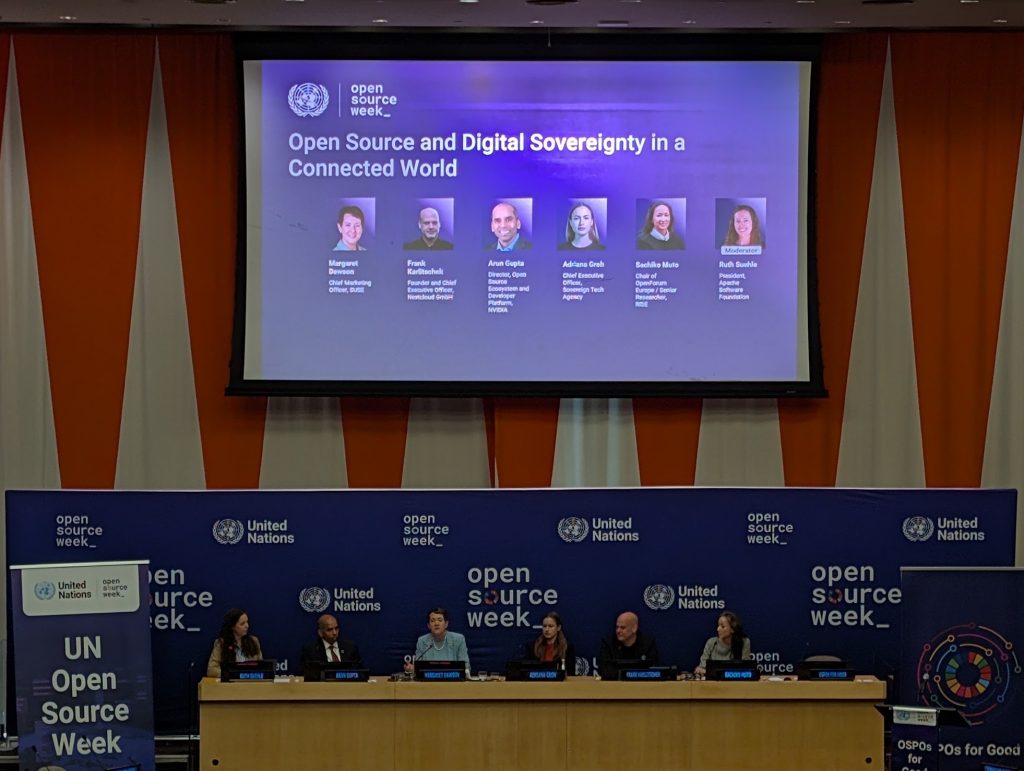
Photo by Ian Ward.
Sustainability and maintenance of open source public goods
One of the major debates at the conference was the question of what support governments can get for using open source applications, the vendor support ecosystem and how can DPI based on open source technology be made more sustainable over the long term.
“Maintenance was a major topic. Some successes, like Drupal foundation’s model for recognising contributions, were presented but there is no one formula that solves the problem of paying for the work that keeps OS projects functioning. Open Source governance and community engagement were also frequently discussed.
“Open Source Program Offices were recognised as a major part of the solution. They are a centre of excellence for interacting and contributing to open source projects on which government and private sector organisations rely. It’s not enough to change procurement policy, organisations need to lean in and support the projects they use with direct contributions to their communities.”
The maintenance issue is linked to a much wider debate as to whether users of open source software should not just free ride but also contribute to its creation and upkeep. This is, in turn, linked to ongoing concerns about whether critical open source software is receiving adequate, sustained attention and development resources, so they can remain robust and reliable.
Also to read:
What is the true value of open source software? It depends on what you’re measuring
Open source technology and AI
Last year’s Open Source Week saw major discussion on AI and open source, with many participants stressing that open source is a democratising force in AI, that can foster transparency and accelerates collaboration. These discussions continued at the 2026 event.
“Ethical AI use was another major topic, with some voices pushing to embrace the hyperscalers and others championing a more nuanced approach, recognising limitations and opportunities in various models.”
“Open source AI models also mean that AI capacity won’t be concentrated in wealthy countries,” stresses Ian. These models offer the possibility of democratising the technology for poorer countries. Discussions also took place about how to ensure AI is developed and governed in an ethical and inclusive way, that leads to a narrowing of the digital divide rather than increasing it.
“My panel discussed the meeting of AI tools and data publishing. We covered ethical practices and how to ensure the reliability and provenance of data and answers shared with the public. CKAN’s role in capturing, sharing and even generating this important metadata featured prominently. There is real excitement around efforts to improve and share metadata standards. I was approached by several people after the panel and hope to have more to announce soon.”
Want to build a CKAN-based open or internal data portal?
Contact us and one of our data experts will be in touch.