Based in Kharkiv, Ukraine, Sergey Motornyuk is one of Link Digital’s Senior Solutions Architects. He has been involved in the Comprehensive Knowledge Archive Network (CKAN) ecosystem for over a decade and is a core member of the CKAN Tech Team. He has a very hands-on and in-depth understanding of the CKAN platform’s evolution and where it needs to go to stay relevant.
For CKAN Insider #4, I spoke to Sergey about how the software has changed over the last decade, what the current upgrade path to CKAN 2.12 looks like, and what the next major upgrade – CKAN 3.0 – will mean for organisations running data portals?
From small publishing platforms to a complex open data ecosystem
In the early days, according to Sergey, most organisations used and operated CKAN data portals mainly as small publishing platforms, to which they uploaded data sets.
“The biggest change from my point of view is how organisation governments look on their portals and which function they expect from [the CKAN ] ecosystem. Basically, instead of just static catalogue, portals have turned into complex systems with API integrations, with analytical tools, with just spatial previewing, etc.”
Another major change relates to CKAN’s “stability and scalability”. Ten years ago, deployments often required a significant amount of manual labor and maintenance. “Today CKAN is much more advanced and mature in terms of extendibility, etc. It’s compatible with cloud ecosystems. It has solid security practices. Now almost everything in CKAN can be automated and it almost requires no manual labor at all. It [CKAN] can be deployed just in a few clicks and it’s really impressive.”
CKAN 2.12
Sergey is currently involved in preparations for the release of CKAN 2.12, the final release in the 2 series, before the next major software upgrade, CKAN 3.0. The 2.12 upgrade contains several significant improvements that portal operators should know about.
“It has a lot of wonderful things, but probably one of the most important is the fact that we move away from legacy technologies and huge technical debt, and now anyone who upgrades to CKAN 2.12 will be able to jump into version three with the least possible amount of effort.”
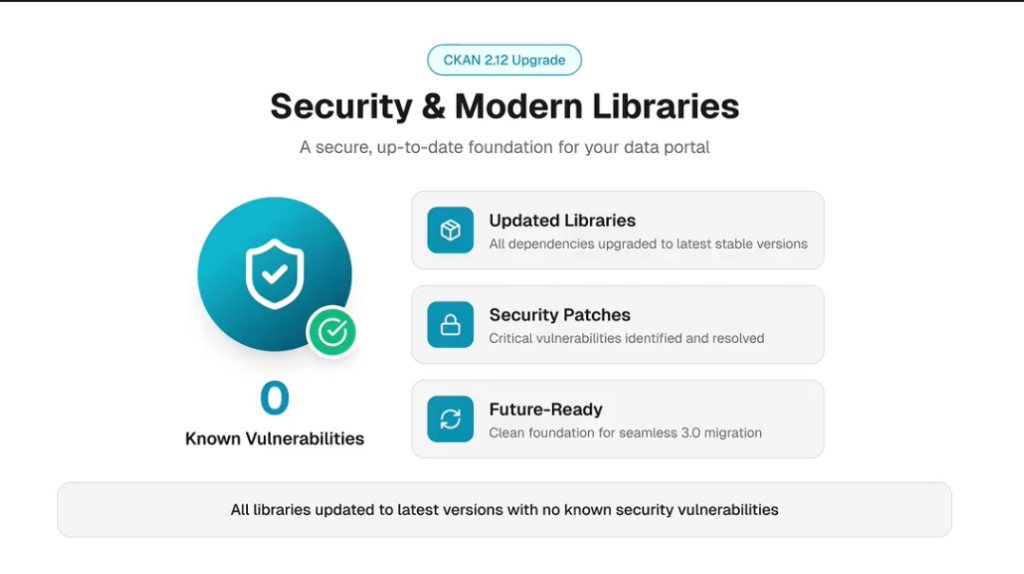
“Previous versions of CKAN often relied on some old or even unsupported libraries just because we had no capacity to update it. In version 2.12, absolutely every library is updated to the latest available version.”
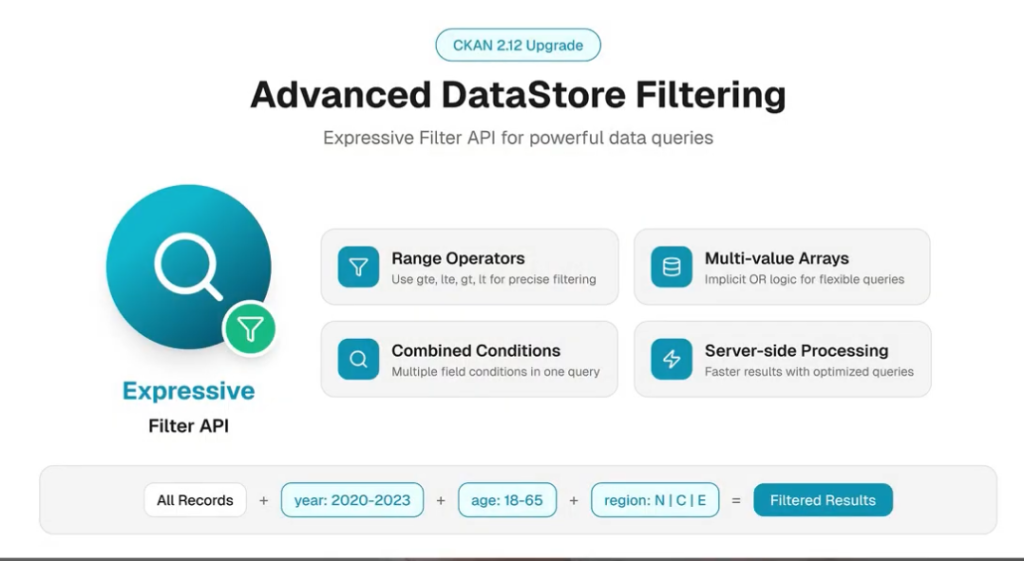
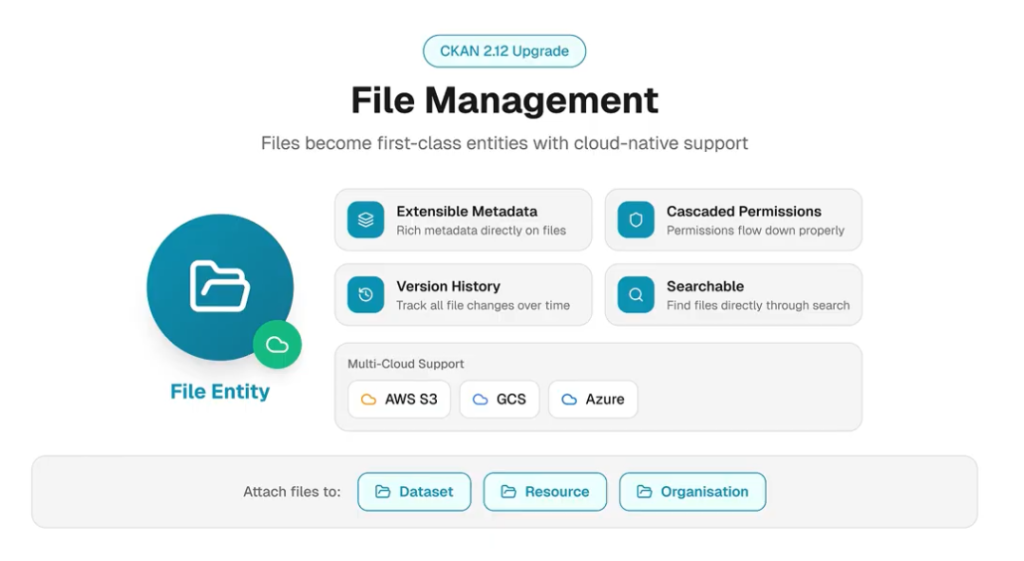
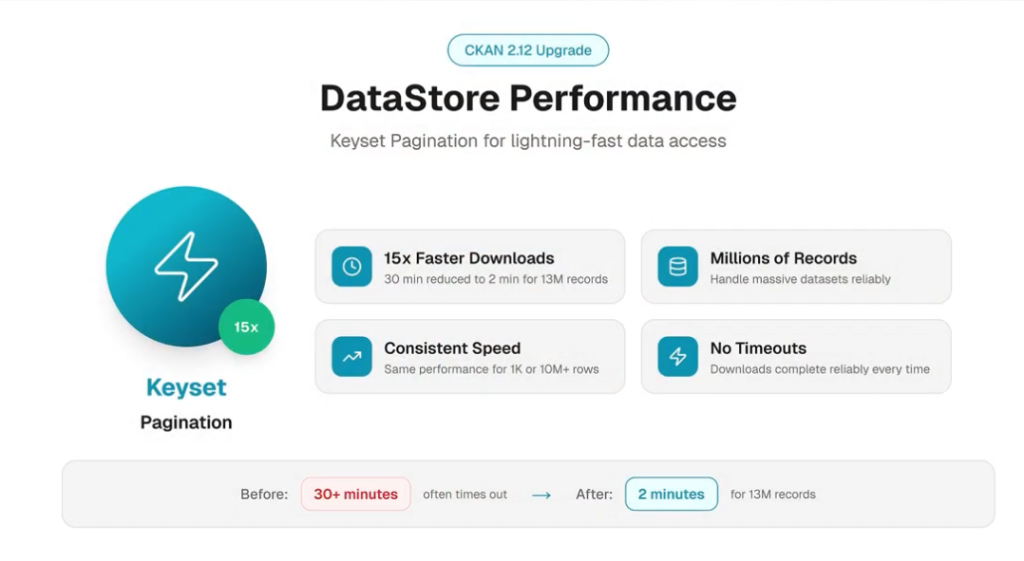
Other important features include improved search engine support, performance enhancements for the CKAN Datastore, and changes in the file management ecosystem for simplified cloud storage communication.
Sergey stresses that an exact go-live date for CKAN 2.12 is coming soon. The process is community-driven and depends heavily on final testing and coordination among contributors. “Basically, we have two issues, both are related to DataStore, and they are connected to some security and performance issues. As soon as we are done with them, we will need like an extra week just to properly test and bundle everything and it will be published.”
Countdown to CKAN 3.0
A key focus of CKAN 3.0 will be the removal of old, duplicated, or slowed-down elements from the CKAN core to enable future development. “There are still some either old or duplicated things that slow down the development, and we want to rip them out of CKAN core and remove everything that blocks us from even further development.”
While there may also be work undertaken to change some API compatibility level issues, ideally, the migration from CKAN 2.12 to 3.0 should be a smooth process, potentially requiring only about a day of development effort. Sergey also anticipates a lot of effort will be put into modernising the front-end architecture and making the platform easier to extend and maintain for the next decade.
While CKAN 3.0 is still some time off, Sergey states that there are things that organisations that use CKAN can do now to prepare. “Many portals have accumulated tons of custom code and it’s a good moment to evaluate whether all these customisations are still necessary.” Organisations should also “review their code to ensure it follows the best practices recommended by CKAN, making sure their custom code is modern and compliant.”
A long-term project, not a short-term sprint
According to Sergey, the most common mistake organisations make involves treating their CKAN portal as a one-time project instead of a long-term, living ecosystem that requires continuous maintenance.
“A CKAN portal always requires maintenance. When [a] new version is released, ideally the portal must be upgraded but even without it [there must be] periodic checks of dependencies, of metadata quality management. Everything must be in place or else the portal will just accumulate a huge amount of unreliable data, and no one will just use it.”
Another common mistake is excessive customisations without putting a long term plan in place behind them. “Custom features can solve immediate problems but over time they really make upgrades significantly more difficult and that also correlates with my mention of best practices. Basically, whenever a custom feature is implemented, it should be aligned with CKAN recommendations, and every new version should be checked against this feature because sometimes it becomes possible to write the feature better.”
Staying relevant in the face of major challenges
Sergey is adamant that the global community around CKAN is one of its greatest strengths.
“A single maintainer cannot really solve all the problems and all the challenges, and data management can benefit from a diversity of governments, universities, non-governmental agencies and independent developers around the world. They have their own way to manage data to publish data. They discover they have different priorities and experience, and that diversity and experience tends to make the platform more robust. The community creates this transparency and resilience. Organisations… can also affect the road map of CKAN and make it more suitable to their needs.”
Another major benefit of this community is knowledge sharing. “The global community [has] accumulated years of operational experience across hundreds or maybe even thousands of portals globally and sharing this experience can help everyone to avoid the same mistakes and move further in building an ideal portal.”
But on the occasion of CKAN’s 20th anniversary, Sergey sees challenges, as well as opportunities, ahead.
“I think that CKAN needs to continue evolving from a mere data catalogue into [a] broader data discovery platform. AI is changing how exactly people interact with information. Users expect, maybe demand, the availability of semantic search, automated metadata generation, and maybe a chat-like interface where they can communicate with the portal itself to discover something and probably integration with some advanced analytical systems or models.”
CKAN manages valuable, structured, and trustworthy public data, which is an asset for AI systems. He believes future focus areas should include improving metadata quality and interoperability, supporting AI-assisted discovery, and making the API more structured and supportive of machine-readable formats.
Watch the full interview with Sergey here on our YouTube channel.
Link Digital team provides CKAN managed hosting and consultation. Reach out to start your 2.12 upgrade.