The content management software known as Drupal powers a significant share of the websites run by governments, universities, and international organisations. It’s stable, secure, and built on open standards. But like any platform, it has a release cycle, and 2026 is shaping up to be a pivotal year for anyone still running older versions.
If your site is on Drupal 7, Drupal 10, or any release in between, now is the time to plan your next move. Here’s what you need to know to do it successfully.
Drupal 7 is already unsupported
Drupal 7 reached its official end of life on 5 January 2025, after 14 years in service. The Drupal Association and the Drupal Security Team no longer release security advisories, patches, or compatibility updates for it.
If you are still running Drupal 7, your site is prone to issues. For organisations subject to compliance frameworks such as PCI, HIPAA, SOC 2, or FedRAMP, running unsupported software can create more than a security problem, it can create a compliance problem.
There is no direct upgrade path from Drupal 7 to modern Drupal. Moving forward means rebuilding the site on the latest Drupal codebase, migrating your content, and reimplementing custom functionality. It is a project you should be scoping now, not later.
Also read: Drupal – why organisations should use it as part of their open data management.
Drupal 10 is next in line
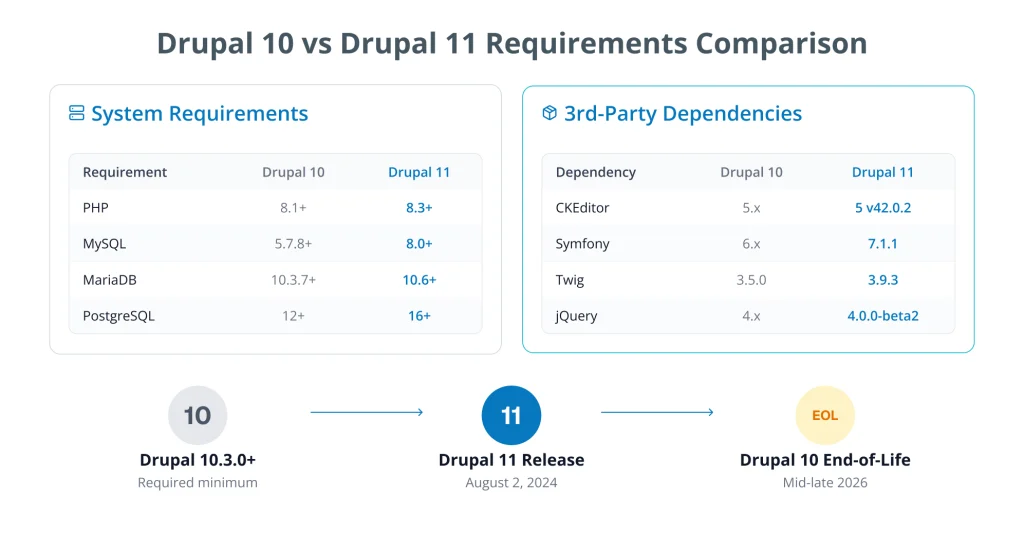
Drupal 10 will reach end of life on 9 December 2026, a fixed date set by the Drupal core release managers. That gives teams on Drupal 10 roughly eight months to plan and execute an upgrade to Drupal 11.
The jump from 10 to 11 is far more manageable than a Drupal 7 migration. Drupal 10 and 11 share a continuous upgrade path, provided your site is on Drupal 10.3.0 or later release, and provided your contributed modules and themes already have Drupal 11 compatible releases in place. The Drupal upgrade documentation sets out the full checklist.
Drupal 12 is on the way
The Drupal core team is currently targeting the release of Drupal 12 for the week of 10 August 2026, with a beta deadline of 15 May 2026. If that deadline slips, the fallback window is the week of 7 December 2026.
A word of caution for anyone tempted to skip ahead. While Drupal 12 is targeted for release in 2026, there is always a lag before major contributed modules become compatible. For existing sites, a Drupal 12 upgrade is probably not feasible until at least early 2027. Furthermore, Drupal does not support leapfrogging major versions. You cannot jump from Drupal 10 straight to Drupal 12. Each major version must be passed through in sequence, which is another reason teams still on Drupal 10 should be planning their Drupal 11 upgrade now.
What a Drupal upgrade actually involves
Every Drupal upgrade is different, but most projects share the same shape. We start with an audit of your core, contributed modules, and custom code, typically using the Upgrade Status module available on Drupal.org. From there, the work usually includes bringing your site to the latest minor release of your current major version, updating or replacing any modules that are not yet compatible with the target version, reviewing configuration, refactoring any deprecated APIs, and rigorous testing across development, staging, and production environments before cutover.
For government and public sector sites, the stakes are higher. Downtime, accessibility, and continuity of citizen services all need to be factored into the plan, not bolted on at the end.
Get ahead of the deadline
Link Digital has been delivering Drupal development and managed hosting for government agencies, universities, and international organisations for more than two decades. We have migrated Drupal 7 sites to modern Drupal, upgraded Drupal 10 sites to Drupal 11, and provided ongoing support so our clients are never caught out by an end-of-life deadline.
If you are weighing up a Drupal 7 rebuild or a Drupal 10 to 11 upgrade, we can scope the work, assess your module dependencies, and deliver a migration plan built around the December 2026 deadline.
Message Link Digital today to talk through your options.