Key Takeaways
- Key functions of ARTM’s new Data Mobility Hub: To centralise access to the mobility data, improve sharing and collaboration around mobility data, and create data products.
- Link Digital’s major design challenge: Extending CKAN’s core functionalities to them to be responsive to what the ARTM wanted, while making sure that CKAN remained completely secure.
- Avoiding data management frictions: Provide data publishers and contributors with maximum autonomy rather than forcing data managers to handle all publishing tasks.
- Key lesson: Have a clear understanding of the product you want to develop at the very beginning and draw inspiration from what’s being done elsewhere.
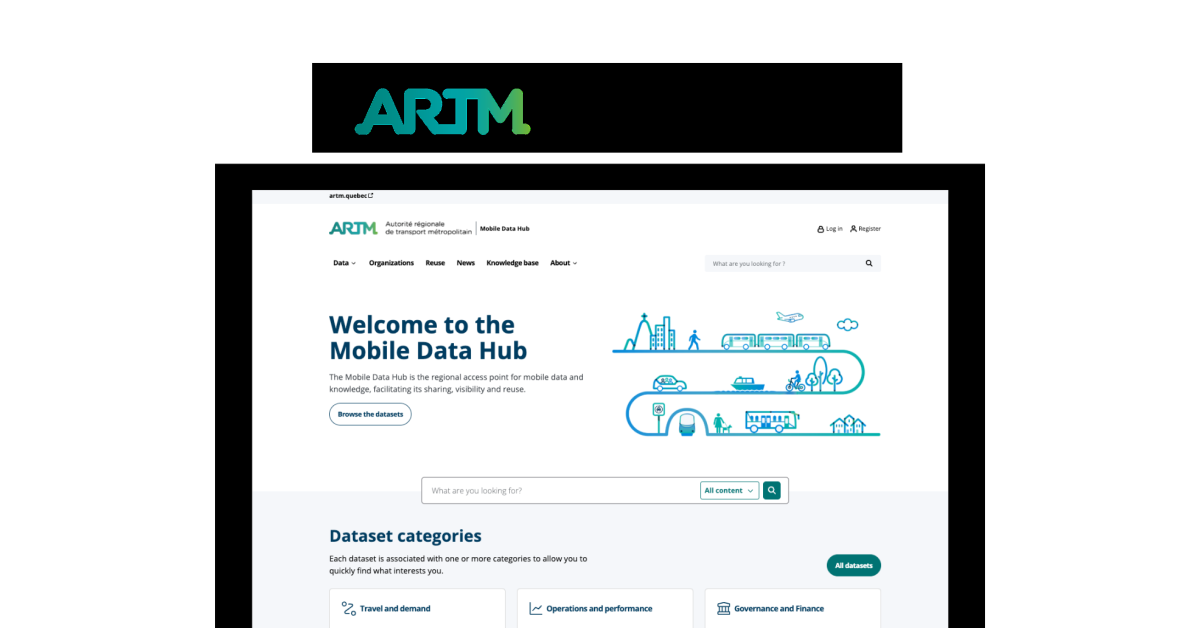
For Philippe Fortin, Principal Advisor, Data Governance, Development and Performance at Montreal’s Autorité régionale de transport métropolitain (ARTM – in English, the Metropolitan Regional Transportation Authority), the rationale behind the organisation’s new Mobility Data Hub is simple:
Data is essential to carry our job out effectively.
The same motivation could be behind pretty much every public sector agency data portal. But what exactly does this mean in practice?
What considerations go into the conception and design of an open data portal and, in the case of ARTM, the decision to go with Comprehensive Knowledge Archive Network (CKAN) as the Hub’s core technological backbone?
I spoke to Fortin about these, and other matters related to the Hub, one of Link Digital’s latest digital public infrastructure projects.
Key aims of the Hub
The ARTM is the statutory body responsible for planning, organising, financing, developing and promoting public transit and paratransit services in the Greater Montreal metropolitan region, Canada’s second-largest metropolitan area and home to approximately 4.5 million residents. The ARTM was created in 2017, its service remit includes rail and bus services, shared taxis, paratransit, and school transportation.
The Hub has been designed with several key strategic priorities in mind.
The first one would be to centralise all the access to the mobility data that we have into our metropolitan region,
says Fortin. Prior to its creation, public mobility data in the Greater Montreal region was fragmented and spread across numerous sites and organisations.
So, if people are looking for any data relating to mobility, they can directly come to the same entry point, which is the Data Hub.
Once people have access to the data, we want to encourage them to share the data and knowledge they develop and create using that data. So, if you created an article, if you created a project, a video, any kind of indicators, insight, anything like that, we would like to be able to reference it to the Hub and have it available to the whole community.
In addition to improved data access and shareability, it [the Hub] will facilitate improved networking and collaboration opportunities between different actors in the Greater Montreal region and serve as a platform to showcase mobility related projects and research and show the value of data creation and re-use.
As well as being used to help inform and improve the ARTM’s own service delivery and decision-making, the data will be used to meet public concerns around a range of issues, everything from traffic congestion to climate change and the cost of living.
This links to another intended function, developing and experimenting with the creation of new data products.
Basically, this involves asking questions about how we can create value with the data before even publishing.
Fortin cites road safety or calculating emissions from the transportation industry, as two possible examples.
It will hopefully involve putting different actors, organisations, people around a table and discussing what objective do we have in common… And then we want to mobilise and kind of create an energy around this community as well. That might be just promoting the Hub, responding to different questions people have and then also keeping developing the Hub’s functionalities based on the feedback we get from the users.
The process of selecting CKAN
CKAN was one of several platforms that the ARTM’s procurement process considered for the Hub.
What we did first is define the key business requirements we had for that Hub. We assigned some of those as mandatory and others as optional. We shortlisted the solutions and then we developed practical scenarios like, ‘how do you publish data?’, ‘how do you manage it?’, ‘how do you change the different settings for the different roles and permissions for accessing data sets, visualisation?’, etc. This was combined with scenario planning by colleagues at ARTM, and a look at the public documentation about various solutions, including those offered by private companies and private solutions.
In the end, CKAN proved to be the most cost-effective and offered a greater flexibility to develop those new features that would respond to the community needs and kind of achieve our goals over time.
Avoiding data management frictions
The Hub includes CKAN for data storage, metadata creation, data dictionaries and glossaries, and a new publication workflow functionality, which Link Digital specifically architected to CKAN to meet ARTM’s unique needs. Drupal was used for user interface and public-facing content management, including the creation of customised web forms and data sharing agreements.
This work involved customising and extending several of CKAN’s core functionalities, with Link Digital’s developers having to think through what the least modifications were possible to make the product responsive to what the ARTM wanted, at the same time as making sure that CKAN remained completely secure.
Was Fortin surprised by just how flexible and adaptable the CKAN software is and what it was able to do?
I wasn’t surprised because I’ve worked with CKAN when I worked for the city of Montreal, and I already knew its capability. However, the one thing I was pleased with when we worked with Link Digital, is how easily all the new features could be added, while still maintaining the level of security that you kind of expect from CKAN.
The ARTM and Link Digital designed the Hub to avoid several key data management frictions. One of these was providing data publishers and contributors with maximum autonomy rather than forcing Hub maintainers to handle all publishing tasks.
Because that was one thing in the past, when we worked in another context, that as a hub maintainer or a CKAN portal maintainer, we would have to do most of the things for everybody. Because they were either not able to do it or they didn’t have the granular permissions to do stuff by themselves. That’s one thing we worked on with Link Digital, to create those granular roles and permissions, so they can manage their own content.
The ARTM also worked with Link Digital to give publishers more control on how they share information with data users. This includes adding a notification centre, a subscription system, email updates, and customised activity feeds, so publishers can manage content and communicate data set changes directly to end users.
The private sector mobility data blackspot
The Hub is currently pulling data from a diverse range of public sector organisations. One black spot is private sector mobility data, which Fortin hopes the Hub can eventually cover, although he is under no illusion as to how difficult this could be.
As you know, at first glance there’s not really any incentive for any private organisations to participate in this kind of initiative. So, we need to differentiate ourselves with how we approach this.
Fortin nominates the previously mentioned data use cases as one potential way to pull in private sector participants.
A few of these use cases that have been brought to our attention that could involve private sector partners.
He mentions using data to help calculate vehicle emissions,
as a good angle or good entrance point for the private sector.
Future plans
Launched in October, the Hub has already generated a positive response.
People are enthusiastic about the arrival of a new tool in the ecosystem, and they’re also interested to see where the ARTM will take the project. So, it’s kind of our turn to prove ourselves and continue promoting the initiative. We’ve also had a good reception from the academic community, knowing that there are a lot of needs coming their way for sharing, accessing and using data.
I mentioned the notification centre, which has not yet been made public. There are a few tweaks we need to do on that feature before we release it, but I think that’s going to help a lot.
We want to focus on data validation and data literacy as well, through storytelling. There’s a lot of stuff we do at the ARTM that could translate really well into storytelling, so that’s one thing we want to focus on.
There have also been discussions – and these are only discussions right now – about experimenting with how we can bring natural language to the data hub. That’s one thing we want to explore in the next few months.
Lessons and advice for those planning a data hub
Fortin has one lesson and one piece of advice for those about to start the process of creating their own data hub.
I think the lesson that is the most important one for me from this experience, is really to have a clear vision of the product you want to develop and have a clear vision of the direction you want your team to take. Spend quite a bit of time at the beginning of the project to make that clear.
This is also important in terms of getting approval from decision makers. It also makes it easier to prioritise when you inevitably run out of time.
My advice would be to draw inspiration from what’s being done elsewhere. You’re probably not the first one to do this kind of project. Take those ideas and that experience and then adapt them to your own product and to the direction you want to take.
According to Fortin, the reality is that there is probably something like your intended project out there.
Take whatever is there and if it doesn’t exist, then you can kind of create it on your own, but don’t reinvent the wheel.