Open source software (OSS) has a rapidly increasing share of the global software market. According to a leading market research company, the global open source services market size had reached US$40.6 billion in 2025, a trend that is expected to continue. This growth includes growing uptake by the private sector, including smaller enterprises, and the rise of what are known as permissive open source licences that impose minimal restrictions on software users by allowing them to incorporate the OSS into proprietary applications.
OSS has a source code that anyone can inspect, modify, and enhance, as opposed to proprietary software, for which the source code is exclusively controlled by the person, team or organisation that created it.
But despite its uptake, many organisations and businesses remain wary of using OSS for a variety of reasons. Let’s briefly overview the key areas in which OSS can provide superior outcomes in the management of your data infrastructure needs, compared to proprietary solutions.
Cost effectiveness
Proprietary software providers are primarily focused on increasing their market share and often charge high upfront costs or reoccurring subscription fees. As a result, scaling or modifying proprietary data infrastructure can be expensive and usually requires buying more licenses or products.
OSS is free to download and use. There are no licensing fees per user, which allows for scaling without increased software costs. Financial outlays are instead associated with the costs of hosting and customisation by a third-party service provider, and/or the technical skills and workforce upskilling to use it. These are much less than the typical license fees associated with proprietary software and are a constant regardless of the solution you are using. Additional cost savings can also be generated through the software’s interoperability, easier integration and customisation, and reduced barriers to reuse.
Transparency and avoiding vendor lock-in
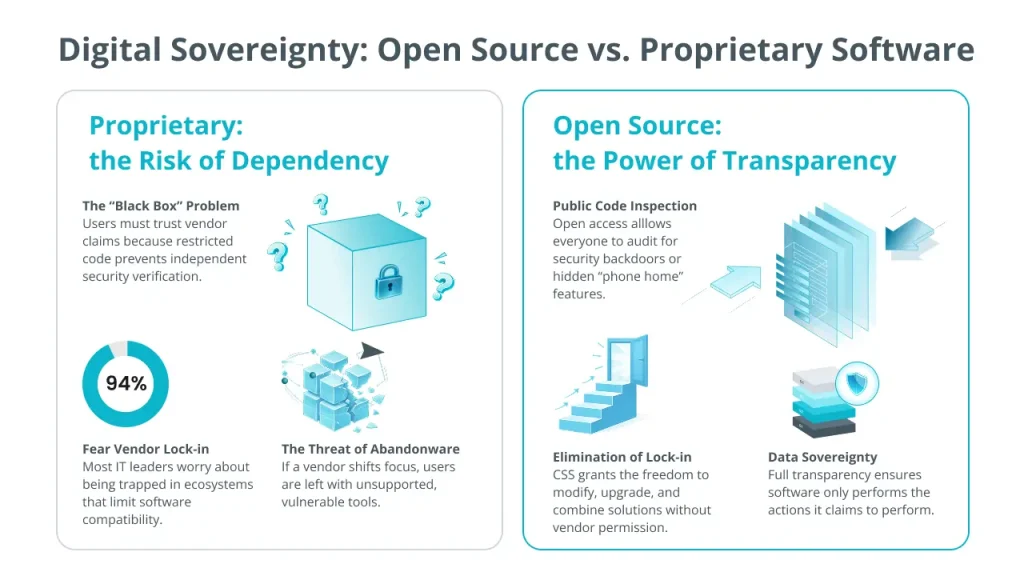
The fact that proprietary software is restricted or closed prevents users from accessing, modifying or distributing the code. It also means you have no choice but to trust the vendor’s word that they are handling your data securely, and the software does only what it claims.
Indeed, their focus on market share means proprietary vendors have a financial incentive to make their tools work best, often only, with their own suite of products. Likewise, if the company folds or shifts focus, the software can become ‘abandonware’, leaving you with unsupported, vulnerable tools, or forcing you to migrate to another solution at a potentially high cost. This is known as ‘vendor lock-in’, when users become dependent on a specific vendor for updates, support and maintenance, and compatibility with other software and, and cannot easily switch to an alternative solution or another vendor.
OSS eliminates the risk of vendor lock-in by giving users the freedom to modify, upgrade, tailor or combine software solutions. Because it is public and fully accessible, anyone can inspect the source code of OSS for security backdoors, privacy leaks, or ‘phone home’ features (mechanisms built into software that automatically send data from your device back to the developer’s servers).
Similarly, you own your data and tools. If a developer stops supporting the project, the community (or your own team) can fork the code and keep it alive.
Easy customisation
The fact that proprietary software is a closed system, and users are dependent on whatever preset options or application programming interfaces the vendor provides, makes it complex, time consuming and expensive to modify to meet your changing needs or integrate new applications.
OSS components, like CKAN, are designed to be modular. Users can swap one component for another without having to rebuild their entire data infrastructure. This makes OSS highly customisable and enables users to vastly increase its basic functionality and integrate seamlessly with a user’s existing data and digital operations.
Enhanced security and code transparency
With proprietary solutions, all security updates and maintenance are handled by the vendor’s internal team.
OSS, on the other hand, can be made highly secure by proper configuration and adherence to best practice security protocols and access controls within the host organisation, as well as by engaging the expertise of a third-party service provider. The fact that open source solutions deliver complete source code transparency promotes visibility and that maximises the number of individuals examining the code. With more people checking the code, any vulnerabilities can be identified quickly, leading to fast updates and strong security practices.
Most OSS products, like CKAN, can also draw on a global community of developers and users that constantly audits the code. This user base also provides support, advice and resources to in-house developers, and oversees the regular release of security patches and updates to address vulnerabilities and improve overall security. This means vulnerabilities are often caught faster than a single company can do.
Innovation that is not reliant on your vendor
For proprietary software solutions, innovation happens at the pace of the vendor’s internal R&D cycle and is often dictated by their financial bottom line and market interest rather than user needs.
In contrast, ideas flow across the OSS community. New features and patches are regularly released because contributors from different companies and organisations collaborate.
Link Digital would argue OSS is particularly suited to public sector governance data management needs. OSS’s flexibility and easy customisation offers the potential to leverage collaboration between government and the broader digital ecosystem, for example, between public officials and the open source communities. This not only exposes governments to a wider base of IT talent, but to new skills and ways of working, with flow on impacts in terms of improved data management and data informed decision making skills.
Data ownership
While you own the content of your data, in proprietary solutions the vendor controls the infrastructure. If the vendor changes their terms of service, for example, to train AI models on your proprietary data, you may have little legal recourse other than to stop using the service.
OSS is in sync with the shift taking place from data ownership to digital sovereignty. For organisations that increasingly rely on AI and cloud-based systems, a vital question becomes not ‘who has the file?’ but ‘who controls the life cycle, access, and legality of the data?’ With OSS you own the entire tech stack. You decide where the data is stored (on-premises or in a specific jurisdiction), who can access it, and how it is processed. This also means that users decide whether their data is used for AI training.
Similarly, the data is in open, readable formats, meaning that if you decide to stop using a specific open-source tool, your data remains in a universal format, allowing you to move it around, as you need.
Interoperability and open standards
Proprietary software often uses a closed ecosystem or secret file formats which are designed and maintained by the owner. This makes it difficult for users to switch to a competitor’s product. If a proprietary vendor goes bankrupt or discontinues a product, your data can effectively be left in a file format that no other software on earth can understand.
While proprietary software often uses compatibility as a competitive lever, OSS treats it as a foundational requirement. OSS prioritises open standards to ensure they can integrate with a wide variety of other tools. Because the code is public, any developer can build a bridge to it. This also means that if an open-source project stops being updated, your data is still stored in a standard, readable format. You can simply use a different tool to open it.
Open source: the right choice for your data infrastructure
Choosing the right open data platform is critical. OSS offers extensive benefits over proprietary systems, including unmatched customisation, avoidance of vendor lock-in, and full data control, including the ability to decide whether your data is used for AI training. By opting for OSS, organisations can not only meet their current data needs but also future proof their digital infrastructure for emerging challenges and opportunities.
Case study: from proprietary to open source
Interested in making the switch from proprietary to OSS? Read our interview with Miles Dunkin, data manager of the Resource Markets Branch of New Zealand’s Ministry of Business, Innovation and Employment, about how they replaced the proprietary software used to run its online data storage platform, with the open source CKAN, and the benefits this brought.